




Crime stories move fast. Don’t miss the next one.
For more shocking cases, strange headlines, viral crime videos and updates from It’s About Crime, follow us on X.
Follow us on XA young woman has died after she was thrown from a bridge during an extreme rope jump in Brazil, allegedly before the safety line had been attached.
Maria Eduarda Rodrigues de Freitas, 21, was taking part in a rope jumping activity at Ponte do Esqueleto, known as Skeleton Bridge, in Limeira, São Paulo, on Saturday, June 13.
The bridge, an abandoned railway structure, has become a known spot for thrill-seekers. But what began as a planned jump ended in horror when Maria fell around 40 metres to the ground.
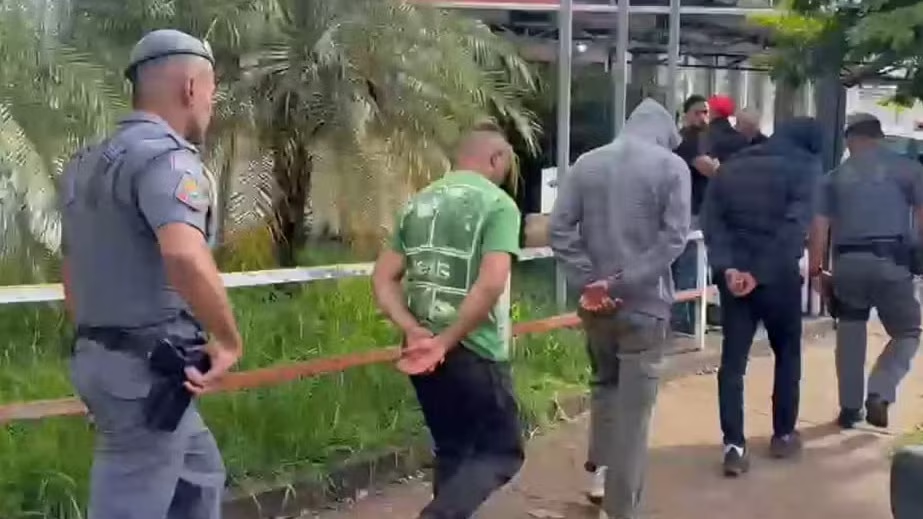
Police have since arrested three men linked to the activity as investigators look into how such a basic safety failure could have happened.
Maria was lifted and launched from the bridge
Footage from the scene has since spread online.
In the video, Maria appears to be lifted by two men and held above their heads before being launched from the bridge in a “Superman” style jump.
Almost immediately, people nearby seem to realise something is wrong.
According to CBS News, the safety equipment had not been properly secured when she went over the edge.
“The safety equipment was not properly secured at the time of the jump. The victim did not survive the fall,” police said in a statement reported by AFP.
The detail has made the case especially disturbing. Maria was not attempting the jump alone. She had joined a guided activity where safety checks should have been the most important part of the process.
Police arrest three men after fatal fall
Three men have been arrested in connection with Maria’s death.
They have been named in multiple reports as Luis Felipe Feliciano Egoroff, 32, Vitor de Freitas Gonçalves, 27, and Maicon Fernandes Cintra, 42.
The men are being investigated on suspicion of homicide with dolus eventualis.
That does not necessarily mean police believe they set out to kill Maria. In Brazilian law, the term can apply when someone allegedly takes an action while accepting the risk that death could happen.
Investigators are now looking at who prepared the jump, who checked the equipment, and who made the final decision to send Maria over the edge.
Why it is being called a bungee jump
Many reports and social media posts have described Maria’s death as a bungee jumping accident.
However, the activity involved was rope jumping.
The difference matters.
Bungee jumping usually uses an elastic cord, which stretches as the person falls and then rebounds. Rope jumping uses a less elastic rope, which creates more of a swing after the fall.
To most people watching, the two activities may look similar. But the safety systems and checks are not identical.
In this case, investigators are focused on the rope that should have controlled Maria’s fall and why it was allegedly not attached.
Witnesses reportedly spotted the missing rope too late
One of the most alarming details reported in the case is that the missing safety connection may have been visible before the jump.
According to reports, the rope that should have been attached to Maria was left coiled on the bridge.
By the time people realised what had happened, she had already been launched.
That question now sits at the centre of the investigation.
How did Maria reach the edge, get lifted into position, and get thrown from the bridge without someone stopping the jump?
Police are expected to examine video footage, witness statements, equipment, and the roles of each person involved.
Skeleton Bridge was already known as a risky site
Skeleton Bridge has attracted extreme sports groups and visitors for years.
Its height and abandoned structure made it a popular spot for rope jumping. But Maria’s death has now placed fresh attention on whether the area had proper control, supervision, or enforcement.
Local authorities are also facing questions over access to the site and whether dangerous activities had been allowed to continue for too long.
The tragedy has turned the bridge into the centre of a much wider safety debate.
Defence says it was a tragic accident
The men linked to the jump operation have reportedly denied any intention to cause harm.
Their defence has described Maria’s death as a tragic accident and said the group had operated for years without a fatal incident.
Police, however, are treating the case seriously.
Investigators will need to determine whether Maria’s death was the result of one catastrophic mistake or a broader failure in how the activity was being run.
The video has sparked outrage online
The story has travelled far beyond Brazil because of the footage.
Online, many people have reacted with disbelief that a participant could be thrown from a bridge before the safety rope had been connected.
Others have questioned how extreme sports groups are regulated and whether viral stunt culture has created a dangerous gap between spectacle and safety.
For Maria’s family, the viral reaction is secondary to the loss itself.
A 21-year-old woman turned up for what should have been a controlled activity. She never came home.
Investigation continues after Maria’s death
The case remains under investigation.
Police are expected to review the full video, inspect the equipment and take further witness statements.
The arrests have not ended the matter. They have only started the legal process.
What investigators must now answer is painfully simple.
Was Maria’s death an unavoidable accident, or did a preventable safety failure send her over the edge without the one thing that could have saved her?