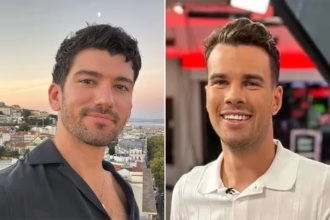







More than 200 crime scene photographs from the Sydney home where Jesse Baird and Luke Davies died have been shown to a jury, revealing new details about the forensic investigation — including a bullet hole that police did not discover until more than two years later.

Former NSW Police officer Beau Lamarre-Condon is standing trial in the NSW Supreme Court accused of murdering Baird, a television presenter and AFL goal umpire, and Davies, a Qantas flight attendant, inside Baird’s Paddington home on February 19, 2024.
Lamarre-Condon has pleaded not guilty to the murder charges.

Prosecutors allege he arrived at the property disguised as an Uber Eats delivery rider before killing both men.
His defence disputes the prosecution’s version of events and argues Lamarre-Condon acted in self-defence during separate struggles involving the firearm.
Bullet hole discovered more than two years later
Among the photographs shown to jurors was evidence relating to a bullet hole in a bedroom door that investigators initially missed.
The court heard the damage was eventually discovered in July 2026.

NSW Police Senior Sergeant Bronwyn Lansley, who was involved in examining the Paddington property after the deaths, gave evidence about the forensic investigation.

The Crown alleges Lamarre-Condon fired through the bedroom door while Davies was attempting to seek help.
According to evidence presented at trial, investigators believe there was nothing positioned between the firearm and the door when the shot was fired.
The damage was allegedly concealed by a hook attached to the door, which meant investigators did not identify it during their original examination of the home in 2024.
Crown prosecutor Brett Hatfield SC has previously told the jury Lamarre-Condon purchased a mounting hook from a Kmart store in Sylvania.
Forensic evidence presented to jury
Jurors have also been shown photographs documenting blood evidence and markers placed throughout the Paddington property during the police investigation.
Testing of samples collected from Baird’s bedroom found Davies was the major DNA contributor to some of the blood evidence, according to material discussed in court.
His blood was also detected in several areas of the room.
Another major part of the Crown’s case concerns a bullet recovered from beneath the flooring of the property.
Prosecutors allege the bullet is connected to the shooting of Baird.
The court heard forensic testing detected a partial DNA match to Baird on blood recovered from the bullet.
Sergeant Lansley told the jury evidence suggested the projectile travelled through blood before entering the timber subfloor.
Investigators also used luminol while examining parts of the house.
Luminol is a chemical commonly used by forensic investigators because it can produce a blue glow when it reacts with traces of blood, although it can also react with certain cleaning products and other substances.
Photographs presented to the court showed several areas glowing during the forensic examination.
Crown and defence offer different accounts
The prosecution and defence have presented significantly different versions of what happened inside the Paddington terrace.
The Crown alleges Lamarre-Condon deliberately went to Baird’s home before killing the two men.

His lawyers argue he went to the property to retrieve belongings and entered using a key that had previously been given to him.
According to the defence case outlined to the jury, a confrontation followed and the deaths occurred during separate struggles involving the firearm.
The defence says Lamarre-Condon’s actions amounted to self-defence.
Those competing accounts will ultimately be considered by the jury alongside forensic evidence, CCTV, witness testimony and other material presented during the trial.
Court hears about Baird and Lamarre-Condon’s relationship
The jury has also heard extensive evidence about the relationship between Baird and Lamarre-Condon in the months before Baird and Davies died.
The pair briefly dated during periods in 2022 and 2023.
Their relationship ended in November 2023 following several disputes, including an incident involving an Instagram post.

The Crown alleges Lamarre-Condon posted an image of flowers to his Instagram Close Friends story in a way that suggested Baird had sent him the bouquet.
Baird could not see the post himself, the court heard, but people Lamarre-Condon allegedly viewed as romantic rivals could.
After learning about the post, Baird confronted Lamarre-Condon by text.
Prosecutors allege Lamarre-Condon initially claimed the flowers had actually been sent to his mother by his stepfather.

The jury heard he later contacted his friend Shae Davison and said he had made a serious mistake before sending her a screenshot showing Baird ending their relationship.
Alleged attempt to explain Instagram post
The following day, Lamarre-Condon allegedly contacted Davison again seeking advice.
According to evidence presented at trial, he sent her photographs showing a woman holding flowers as well as an image of a handwritten note.
The Crown alleges Lamarre-Condon had visited a florist and attempted to recreate the bouquet shown in his earlier Instagram post.
Davison told the court she believed Lamarre-Condon was attempting to explain his way out of the situation after Baird became aware of what had happened.
There is no evidence Lamarre-Condon ultimately sent those staged photographs to Baird.
The court heard he did, however, send Baird a message asking if they could meet so he could take responsibility for something.
Baird did not respond.
Text messages shown to the court
Further messages allegedly sent after the breakup have also formed part of the Crown’s case.
On November 18, Lamarre-Condon allegedly described Baird as a “manipulative player” during an exchange.
He also allegedly contacted another man Baird had been casually seeing and claimed Baird had mistreated him during their relationship.
Five days later, on November 23, the jury was told Lamarre-Condon asked a friend — identified in court using the pseudonym Alex Carrol — whether her former boyfriend could obtain a firearm for him.
The evidence forms part of the prosecution’s broader case concerning Lamarre-Condon’s alleged behaviour in the months before the deaths.
The defence is expected to challenge the significance and interpretation of evidence presented by the Crown as the trial continues.
Trial continues
Baird and Davies died on February 19, 2024.
The case triggered a major police investigation and attracted widespread attention across Australia.
Now, more than two years later, jurors are being taken through extensive forensic material, witness testimony, messages, CCTV and other evidence as prosecutors attempt to prove their case.
Lamarre-Condon maintains his pleas of not guilty.
The trial is continuing in the NSW Supreme Court.