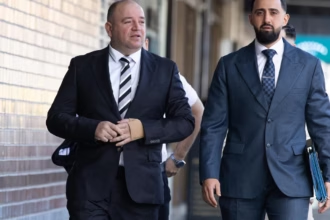






A former NSW police officer accused of killing Sydney couple Jesse Baird and Luke Davies allegedly stalked his former romantic partner, entered his home disguised as a food delivery rider and took steps to conceal what happened afterwards, a jury has been told.
Beau Lamarre-Condon, 31, is standing trial in the NSW Supreme Court after pleading not guilty to two counts of murder and one count of aggravated break and enter.
The long-awaited trial began on September 21, 2026, more than two years after Baird and Davies died at Baird’s Paddington home in Sydney’s eastern suburbs.

During his opening address, Crown prosecutor Brett Hatfield SC outlined what prosecutors allege was a months-long escalation in Lamarre-Condon’s behaviour towards Baird following the breakdown of their relationship.
The allegations remain unproven and will be tested during a trial expected to run for approximately three months. Justice Natalie Adams is presiding over the case.
Crown alleges relationship became an ‘obsessive’ fixation
Baird, a former television presenter, and Lamarre-Condon became romantically involved in late 2022.
According to the Crown, Baird viewed their relationship as relatively casual and initially tried to end it in April 2023.
Prosecutors allege Lamarre-Condon struggled to accept the breakup and subsequently developed what Hatfield described to the jury as an “obsessive and jealous infatuation”.
The pair later resumed seeing each other, but their relationship deteriorated again during 2023.
The jury was told Baird eventually discovered Lamarre-Condon had allegedly accessed his phone, interfered with messages and blocked people he considered potential romantic rivals.
Baird ended the relationship again in November 2023 and asked Lamarre-Condon to stop contacting him.
According to prosecutors, the alleged behaviour did not stop.
Instead, the Crown says it intensified.
Allegations of surveillance and break-ins
The Crown claims Lamarre-Condon repeatedly monitored Baird’s movements during 2023 and early 2024.
Jurors were told he allegedly admitted to following Baird around Sydney’s eastern suburbs and watching him at his Paddington home.
Prosecutors also claim Lamarre-Condon improperly obtained CCTV footage from the Royal Hotel in Paddington while Baird was there on a date.
In another alleged incident, Baird woke during the night in August 2023 and discovered an intruder standing near his bed.
The court heard Baird chased the person from the house without realising at the time who it allegedly was.
The Crown says Lamarre-Condon had entered the property and taken Baird’s mobile phone and wallet. The original court report provided for this article also describes prosecutors alleging multiple incidents of stalking and unauthorised access to Baird’s home and phone.
Jury hears claim of fabricated cancer diagnosis
One of the more unusual allegations outlined during the opening concerns a lengthy message sent after Baird ended contact with Lamarre-Condon.
The Crown claims Lamarre-Condon convinced a female friend to allow him to use her phone before composing a message of more than 1,600 words while pretending to be her.

The message allegedly claimed Lamarre-Condon had been diagnosed with cancer and suggested medication and treatment could explain some of his previous behaviour.
Prosecutors told the jury the diagnosis was fabricated.
The Crown alleges it was another attempt by Lamarre-Condon to re-establish contact with Baird after their relationship had ended.
Jesse Baird begins relationship with Luke Davies
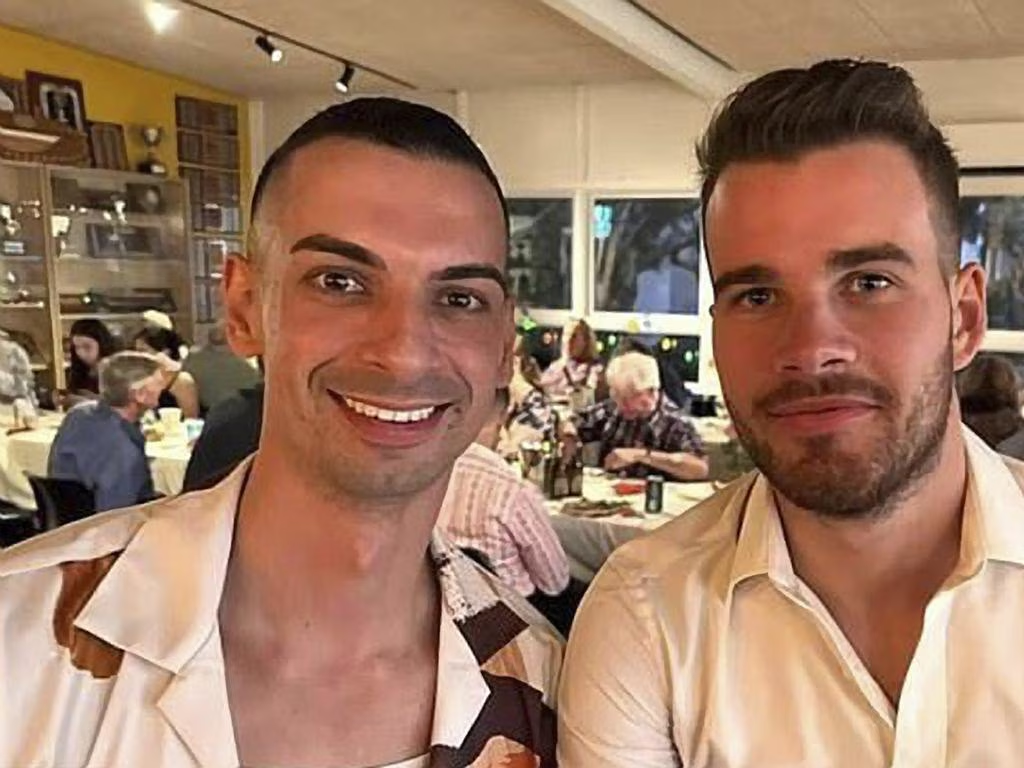
Baird met Qantas flight attendant Luke Davies on New Year’s Eve in 2023.
Their relationship reportedly developed quickly, and the pair began sharing photographs together on social media.
The Crown alleges Lamarre-Condon became aware of the new relationship.
Prosecutors say that by early 2024, his alleged behaviour had moved beyond monitoring Baird and into preparation for an attack.
The jury has been told it will hear evidence concerning a series of actions prosecutors say become particularly significant when considered together.
These allegedly included acquiring a large surfboard bag, changing vehicles, using another phone and researching ways of avoiding detection.
The Crown also alleges Lamarre-Condon retained access to his police-issued firearm despite not requiring it for work at the relevant time.
Alleged disguise outside Paddington home
On February 19, 2024, prosecutors allege Lamarre-Condon arrived near Baird’s Brown Street home and spent several hours watching the property.
The jury was told he allegedly waited until Baird’s housemates had left.
According to the Crown, Lamarre-Condon then changed his appearance to resemble a food delivery rider and entered the property using a key prosecutors say he had previously obtained without Baird’s knowledge.
Inside the home, the Crown alleges Baird and Davies were fatally shot with Lamarre-Condon’s police-issued firearm.
Prosecutors further allege Davies attempted to contact emergency services before he was killed.
Lamarre-Condon has pleaded not guilty to murdering both men.
Crown alleges an attempt to make the couple appear to have disappeared
The prosecution case does not end with what allegedly happened inside the Paddington property.
Jurors have been told Lamarre-Condon then began what Hatfield characterised as an elaborate attempt to remove evidence and create the impression Baird and Davies had simply disappeared.
Their disappearance triggered an increasingly public police investigation.
Lamarre-Condon presented himself at Bondi Police Station on February 23, 2024.
The bodies of Baird and Davies were eventually located at a rural property at Bungonia, near Goulburn, more than a week after they were last seen.
Why the Crown’s timeline will be so important
The prosecution’s opening suggests the case will rely on much more than evidence relating to the events of February 19.
Instead, the Crown is presenting jurors with a chronology stretching back many months.
Alleged break-ins, access to Baird’s phone, surveillance, messages, social media activity, vehicle movements and other digital evidence are being presented as pieces of a larger sequence.
That distinction is important.
Individual incidents can potentially have different explanations when viewed alone. Prosecutors will attempt to convince the jury that, viewed together, the evidence demonstrates an escalating course of conduct and ultimately supports their allegation that the deaths were planned.
The defence will have the opportunity to challenge that interpretation, contest individual pieces of evidence and present its own case.
The jury — not the prosecution, police or media — will ultimately determine which allegations have been proved beyond reasonable doubt.
The case also raised questions about police systems
The deaths of Baird and Davies attracted national attention partly because Lamarre-Condon was a serving NSW Police officer when the alleged offences occurred and prosecutors say a police-issued firearm was involved.
That led to wider scrutiny over how officers access and store service weapons.
The issue later reached the NSW Parliament, where questions were raised about existing systems for recording and monitoring police firearms held outside commands.
The case also had a significant impact on Sydney’s LGBTQ+ community.
Community organisation ACON later told a NSW parliamentary inquiry that the deaths occurred at a time when LGBTQ+ communities were already discussing their relationship with NSW Police following the Special Commission of Inquiry into LGBTIQ hate crimes.
Those broader issues are separate from the question the jury must now decide: whether prosecutors can prove the charges against Lamarre-Condon beyond reasonable doubt.
What happens next?
The trial is being heard before Justice Natalie Adams in the NSW Supreme Court.
A 15-person jury was selected at the beginning of proceedings, with dozens of witnesses potentially expected to give evidence.
Those witnesses could include members of Baird and Davies’ families, friends, former colleagues and housemates.
The Crown began presenting its case on September 21 and was due to continue its opening address when proceedings resumed.
With the trial expected to last several months, much of the evidence described by prosecutors during their opening has yet to be tested before the jury.
Lamarre-Condon maintains his pleas of not guilty.
This article reports allegations currently being heard before the NSW Supreme Court. The allegations against Beau Lamarre-Condon have not been proven and the trial is ongoing.