




There are some crime stories where the courtroom verdict is only one part of what people remember.
The Henry Nowak case is one of them.
Henry was 18 years old. A first-year student at the University of Southampton. He had gone out with friends, like thousands of students do every week, and he should have made it home.
Our Latest YouTube video
Instead, Henry died on a Southampton street after someone stabbed him five times.
His killer, 23-year-old Vickrum Digwa, has now received a life sentence. The criminal case has reached its ending, at least in court.
But the footage that emerged after the trial opened up another story entirely.
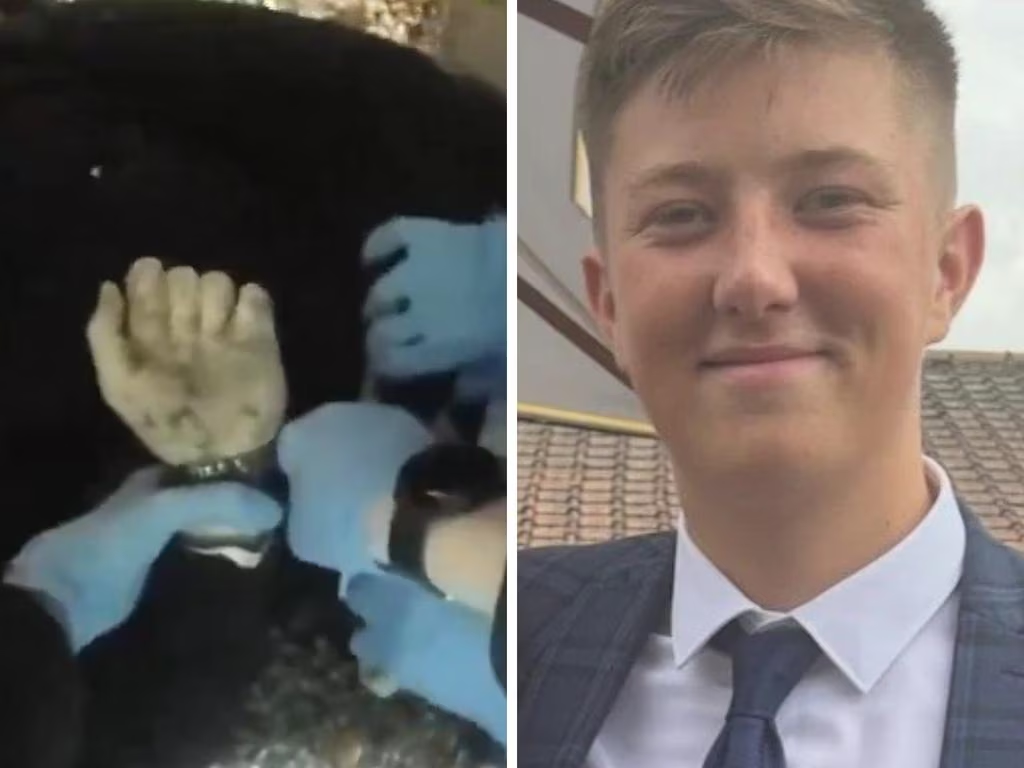
Police bodycam video shows Henry on the ground, badly injured, telling officers someone had stabbed him and that he could not breathe. Moments later, officers handcuffed him and treated him as a suspect.
The video is difficult to watch. It is not just because Henry is dying. It is because he appears to be trying to tell the truth while the adults around him do not seem to believe him.
That is why this case has hit people so hard.
A night out that turned into a murder investigation
On 3 December 2025, Henry Nowak was walking through Portswood in Southampton when he crossed paths with Vickrum Digwa.
What happened next would become the focus of a murder trial.
The court heard that Digwa was carrying a large bladed weapon, described in reporting as a 21cm Sikh dagger. Prosecutors said he also had a smaller kirpan with him, which would have satisfied his religious obligation.
Henry was stabbed multiple times on Belmont Road.
One of the wounds caused major internal bleeding. A pathologist later told the court the injury was not survivable.
That detail matters legally. It may also matter to police. But it does not erase what people have now seen in the video.
Because Henry was still conscious when police arrived.
He was still speaking.
He was still trying to explain what had happened.
The lie that shaped the first moments
One of the most disturbing parts of the case is how quickly the scene appears to have flipped.
Digwa claimed Henry had attacked him and racially abused him. Police arrived believing they were dealing with an assault, not a dying stabbing victim.
According to Hampshire Police, someone told officers that no weapon had played a role.
That false version of events shaped what happened next.
Henry, the teenager bleeding on the pavement, became the person police chose to restrain first.
Digwa had stabbed him, yet officers did not immediately treat him as the killer.
This is the detail that has left so many people furious. Not because police had perfect information. They did not. Crime scenes are messy, frightened people give conflicting accounts and officers have to make fast decisions.
But Henry was telling them something simple.
He had been stabbed.
He could not breathe.

The moment in the video people cannot get past
The newly released police bodycam footage shows Henry on the ground as officers arrive.
He tells them he has been stabbed.
At one point, an officer responds: “I don’t think you have, mate.”
Those six words have now become one of the most talked-about parts of the entire case.
Officers then handcuff Henry and tell him they are arresting him on suspicion of assault. They read him his rights.
Shortly after that, he loses consciousness.
Police later removed the handcuffs and started CPR after they realised how serious his injuries were. Hampshire Police has said officers switched to first aid within minutes.
But for Henry’s family, and for many people watching the footage, that will never be enough.
The issue is not only whether Henry could have survived. The court heard his injury was catastrophic.
The issue is what happened while he was still alive.
A dying teenager was not treated first as a victim. He was treated as a suspect.

Henry’s family say he was denied dignity
Henry’s father, Mark Nowak, has spoken with the kind of anger no parent should ever have to carry.
He said his son did not die with dignity and described the way Henry was treated as “inhumane and degrading.”
That reaction is not hard to understand.
It is one thing to lose a child to violence. It is another to then watch footage of your child handcuffed while begging for help.
The video has turned Henry from a name in a murder report into a real person in his final moments. That is what has made the case so raw.
People are not only reacting to the crime. They are reacting to the feeling that Henry was failed twice.
First by the man who killed him.
Then by the system that should have recognised he needed help.

Vickrum Digwa jailed for life
A jury convicted Vickrum Digwa of murdering Henry Nowak and possessing a bladed article in a public place.
The judge sentenced him to life in prison. Reports state he must serve at least 20 years and 190 days before the parole board can consider his release, a term many outlets have described as a 21-year minimum.
A jury also convicted Digwa’s mother, Kiran Kaur, of assisting an offender after she took the weapon from the scene. The court will sentence her separately.
During the trial, Digwa claimed he acted in self-defence. Prosecutors rejected that version of events.
The court also heard that Digwa misled police after the stabbing. That has become a key part of the public anger around the case, because officers initially responded to a version of events that turned out to be false.
Hampshire Police apologise
Hampshire and Isle of Wight Constabulary has apologised for how officers treated Henry.
Temporary Deputy Chief Constable Robert France said he was deeply sorry officers could not save Henry. He also apologised for officers handcuffing and arresting Henry before he lost consciousness.
The force has said officers were dealing with a confusing and unclear scene.
That may explain part of what happened. It does not make the footage easier to watch.
Police also confirmed they referred the incident to the Independent Office for Police Conduct the day after Henry died.
The IOPC investigation will now look at the police response, including the decision to handcuff Henry, the timing of first aid and the way officers handled the conflicting accounts at the scene.
Politicians and public figures react to the footage
The release of the bodycam footage has pushed the Henry Nowak case far beyond Southampton.
Hampshire Police and Crime Commissioner Donna Jones called Henry’s death a “national tragedy” and said the police response raised serious concerns about “impartiality, fairness and judgement.”
Cabinet Office minister Nick Thomas-Symonds described the footage as harrowing and called the police conduct at the scene “shocking.”
Prime Minister Sir Keir Starmer also commented on the case, calling it an awful and shocking situation. He said it was right that the IOPC was investigating.
Nigel Farage was far more forceful. He argued that the case showed a failure in policing culture and said people should respond with “pure cold rage.”
Reform’s Zia Yusuf also condemned the footage, saying Henry had been handcuffed after telling officers he had been stabbed.
Former home secretary Suella Braverman said Henry appeared to have been treated like the aggressor.
Elon Musk also amplified the case online and reportedly backed calls for transparency over the bodycam footage.
There has been a lot of anger. Some of it has focused on policing. Some has moved into wider arguments about race, crime and two-tier policing.
That is where the case needs careful handling.
Henry’s death deserves scrutiny. His family deserves answers. But the truth of what happened should not get swallowed by people using his name to push a broader agenda.
The religious knife debate
The case has also triggered debate around religious exemptions for carrying ceremonial blades.
Digwa was carrying a large bladed weapon. The court heard he also had a smaller kirpan with him.
That detail has led to calls for a review of knife laws, including from Hampshire Police and Crime Commissioner Donna Jones.
But this part of the story needs care.
Sikh groups have condemned Digwa’s actions and warned against using the case to attack the wider Sikh community. A murderer’s actions belong to the murderer.
The legal question is still important. The public has a right to ask how a young man ended up facing someone carrying a large blade in a public street.
But the answer cannot be lazy blame.
The harder question is how the law balances religious practice, public safety and the risk of someone misusing an exemption in the worst possible way.
Why the Henry Nowak video has stayed with people
True crime stories often go viral because one shocking detail grabs people and refuses to let go. In Henry Nowak’s case, the stabbing is not the only thing people remember. The footage does that too: Henry saying he cannot breathe, the officer replying, “I don’t think you have, mate,” and officers placing him in handcuffs. More than anything, the video shows the awful gap between what Henry knew in that moment and what police believed when they arrived.
That is why people have not moved on from the footage. It shows how quickly someone can lose control of their own story, even while fighting for their life.
Henry was not just a name in a court file. He was a young man trying to make people listen.
What happens next?
The murder conviction does not end the Henry Nowak case.
The IOPC investigation is now the next major step. Its findings will decide whether officers acted appropriately and whether anyone should face further action over the police response.
The Attorney General’s office is also reportedly considering requests to review Digwa’s sentence under the unduly lenient sentence scheme.
There may also be more pressure on the government to review knife laws and the rules around religious exemptions.
For Henry’s family, none of that brings him back.
But it may answer the questions left behind by the video.
Why was Henry not believed?
Why was he handcuffed?
Could police have handled those first minutes differently?
And most painfully, did Henry Nowak die knowing the people around him finally understood he was the victim?
Those are the questions now sitting at the heart of the case.
Henry was 18. He had barely started his adult life.
Now his name sits at the centre of a murder case, a police investigation and a national argument about trust, judgement and accountability.
The bodycam footage has made sure this case will not be forgotten quickly.


