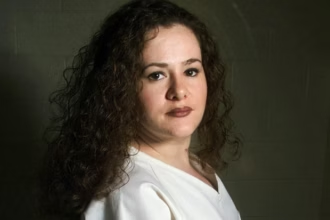




The Mackenzie Shirilla case has returned to public attention after Netflix released The Crash, a true crime documentary examining how an early morning car wreck in Strongsville, Ohio, became a double murder case.
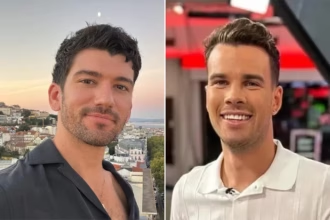
At the centre of the story is Mackenzie Shirilla, who was 17 when she drove a Toyota Camry into the side of a brick building on July 31, 2022. Her boyfriend, 20-year-old Dominic “Dom” Russo, and their friend, 19-year-old Davion Flanagan, were killed. Shirilla survived with serious injuries. What first looked like a devastating accident later became one of the most debated criminal cases in recent US true crime, because prosecutors argued the crash was not a mistake. They said it was intentional.
Netflix’s documentary, which premiered on May 15, 2026, revisits the crash through surveillance footage, bodycam video, courtroom material, phone recordings and interviews with the families involved. It also includes Shirilla’s first public interview from prison, where she denies intending to kill anyone and says she has no memory of the moments before impact.
What Happened in the Mackenzie Shirilla Crash?
In the early hours of July 31, 2022, Shirilla was driving Dominic Russo and Davion Flanagan home after a gathering. According to prosecutors and Netflix’s account of the case, the car turned onto Progress Drive in Strongsville and accelerated heavily before smashing into the Plidco Building near the intersection of Progress Drive and Alameda Drive.
The crash site was reportedly discovered about 45 minutes later by a good Samaritan, who called police. Russo and Flanagan were pronounced dead at the scene. Shirilla was transported to hospital.
At first, investigators considered several possibilities: driver error, mechanical failure, drugs, alcohol or a catastrophic medical event. But the case shifted when surveillance footage and the Toyota’s event data recorder, often called the “black box”, were reviewed.

The Evidence That Turned an Accident Into a Murder Case
The prosecution’s case rested heavily on the vehicle data and the final seconds before impact. The Cuyahoga County Prosecutor’s Office said the Camry was travelling at a controlled speed before Shirilla turned onto Progress Drive, then accelerated to around 100mph. Investigators said the accelerator was pressed fully and the brake was not applied before impact. They also said the vehicle had no defect that contributed to the crash.
Netflix’s Tudum article adds that the car’s event data recorder showed the accelerator had been pressed to 100 percent for the full five seconds of pre-crash data, with no attempt to brake. A forensic auto investigator also found the steering, brakes, accelerator and tyres were functioning properly.
That became the heart of the state’s argument: this was not a teen driver losing control for a split second. Prosecutors argued it was a deliberate act that required engagement, control and intent.

The Relationship at the Centre of the Trial
The case also turned on Shirilla’s relationship with Dominic Russo. On the outside, the couple appeared close. They had been together for years, had recently been living together, and friends and family described them as deeply connected. But investigators later found evidence suggesting the relationship had become volatile.
People reported that Dominic’s brother told detectives Dominic had tried to break up with Mackenzie several times. According to the same report, a friend told police Mackenzie was often threatening to break up with Dominic, and prosecutors pointed to messages and incidents they believed showed escalating tension.
One of the most significant claims involved an incident about two weeks before the fatal crash. Prosecutors alleged Shirilla had threatened to crash the car with Dominic inside, which they later framed as evidence of “prior calculation.” Shirilla’s side disputes the meaning of that incident and says text messages show she claimed Dominic was the one grabbing the wheel and trying to “spin out” her car.
That is one of the biggest discrepancies in the case. The prosecution viewed the earlier incident as a warning sign. The defence side argues it was more complicated and that the jury, or in this case the judge, did not hear enough context.

Mackenzie Shirilla’s Defence: Memory Loss, POTS and “No Intent”
In The Crash, Shirilla says she does not remember the moments leading up to the collision. She does not deny being the driver, but she denies being a murderer. In the documentary, she points to a 2017 diagnosis of POTS, postural orthostatic tachycardia syndrome, and suggests a medical emergency may have caused her to black out.
POTS is a condition that can cause a person’s heart rate to rise abnormally when moving from lying down to standing. Symptoms can include dizziness, fatigue, light-headedness and fainting.
The defence argument is simple but difficult to prove: if Shirilla blacked out or experienced a sudden medical episode, then the crash may have been tragic, reckless or unexplained, but not intentional murder.
Prosecutors rejected that explanation. Their argument was that the car’s movements, including the controlled turn, sustained acceleration and lack of braking, did not fit with someone losing consciousness. Netflix’s summary of the trial says the prosecution argued the driving required “intense engagement” and would have been impossible during a medical event.
People reported that Shirilla and her family later claimed evidence was not properly presented at trial, including material connected to her POTS diagnosis and comments from neurologist Dr Kamal Chemali. According to People, the appeal material claimed elevated lactate levels, low blood oxygen and memory loss could be consistent with a seizure or loss of consciousness, but the testimony was described by an appeals court as speculative.
The Drug Question
Another issue was whether drugs or alcohol contributed to the crash. First responders found marijuana and psilocybin mushrooms among Shirilla’s belongings, and prosecutors said a digital scale was also located. But Netflix reports that the impaired-driving theory weakened because blood toxicology came back negative for alcohol and psilocybin, and positive only for THC.
This matters because it removed one simpler explanation. If the crash had been caused by heavy intoxication, the case may have looked more like a fatal impaired-driving case. Instead, prosecutors argued the absence of alcohol or psilocybin, combined with the vehicle data, made the crash look more deliberate.
The “Black Hole” Inside the Car
One of the most haunting parts of the case is that no one alive can fully explain what happened inside the car in the final seconds. Netflix’s filmmakers described this as the “black hole” at the centre of the case. Dominic and Davion were killed. Shirilla survived but says she has no memory.

That missing piece is why the case remains so divisive. The prosecution used vehicle data, surveillance footage, prior relationship evidence and the absence of braking to infer intent. Shirilla’s supporters argue there is still uncertainty because no one can prove what was happening in her mind or body at the moment of impact.
The Trial and Verdict
Shirilla was tried as an adult and chose a bench trial, meaning a judge, not a jury, decided the case. In August 2023, Judge Nancy Russo, who is not related to Dominic Russo, found Shirilla guilty. The Cuyahoga County Prosecutor’s Office said she was convicted of four counts of murder, four counts of felonious assault, two counts of aggravated vehicular homicide, one count of drug possession and one count of possessing criminal tools.
Judge Russo’s comments became a major part of the public discussion. Cleveland 19 reported that the judge said Shirilla “morphs from a responsible driver to literal hell on wheels” and had “a mission” that she “executed with precision.”
Shirilla was sentenced to two concurrent terms of 15 years to life in prison. Netflix reports her first parole hearing is scheduled for September 2037.
The Appeal Fight
Shirilla’s conviction has remained intact. Cleveland 19 reported that her conviction was upheld in September 2024 after her lawyers argued there was insufficient evidence and clerical errors in the original case.

In March 2026, Court TV reported that Ohio’s Eighth District Court of Appeals upheld a trial court decision denying another appeal because it was filed one day after the 365-day deadline. Shirilla’s side argued the timing should have been calculated differently, including because of leap year issues, but the court sided with the state.
That appeal fight has fuelled another divide. Supporters argue the legal process has prevented key medical evidence from being properly considered. Prosecutors and the courts have maintained that the evidence was strong enough to support the conviction.
The Discrepancies Both Sides Focus On
The biggest dispute is intent. Prosecutors say the crash data, speed, route, lack of braking and prior relationship evidence prove Shirilla deliberately drove into the building. The defence side says the case still contains unanswered medical and factual questions, particularly around POTS, memory loss and whether key text messages were properly used.
The second discrepancy is the earlier driving incident. Prosecutors presented it as evidence Shirilla had previously threatened to crash with Dominic in the car. Shirilla’s side points to text messages suggesting Dominic may have grabbed the wheel during that earlier incident, which could change how the event is interpreted.

The third discrepancy is social media. Prosecutors used some of Shirilla’s social media activity during sentencing to argue she showed a lack of remorse. Netflix notes that Shirilla pushed back on that idea, saying social media is not a true reflection of a person and that she was a 17-year-old trying to control how she was seen.
The fourth discrepancy is the medical defence. POTS can involve dizziness and fainting, but prosecutors argued the final movements of the car did not match a blackout. Shirilla’s family argues medical evidence was overlooked or underdeveloped at trial.
Why Netflix’s The Crash Has Reignited the Case
Netflix’s The Crash is not just retelling the crash. It is revisiting the divide between two completely different interpretations of the same evidence. To prosecutors and the victims’ families, the case is about a deliberate act that killed two young men. To Shirilla and her supporters, it is about a young woman convicted of murder despite claiming she has no memory and may have suffered a medical emergency.
The documentary’s most striking moment may be Shirilla’s prison interview. She says she is “big on the no intent” and insists the crash was not intentional. But Netflix also shows the conditions of that interview, including the presence of her lawyer, which adds another layer to how viewers interpret what she says.
For true crime viewers, the case is uncomfortable because it does not fit neatly into one category. It involves young people, social media, drugs, a toxic relationship, medical claims, forensic vehicle data and a legal system that has so far upheld the conviction.
Where Is Mackenzie Shirilla Now?
As of the latest reporting, Mackenzie Shirilla remains incarcerated in Ohio. Netflix states that her first parole hearing is scheduled for September 2037. Court TV reported in March 2026 that she was housed at the Ohio Reformatory for Women in Marysville.

Her family continues to maintain her innocence. The victims’ families continue to live with the loss of Dominic Russo and Davion Flanagan, two young men whose lives were cut short in a crash that the court has ruled was murder.
The debate around The Crash is unlikely to end soon. But the legal outcome remains clear: Mackenzie Shirilla was convicted, sentenced to 15 years to life, and her conviction and later appeal efforts have not overturned the result.
References and Source Links
- Netflix Tudum, The Crash Recounts a Tragic Car Wreck That Turned into a Murder Case
- Netflix Tudum, Mackenzie Shirilla Speaks for the First Time in The Crash
- Cuyahoga County Prosecutor’s Office, sentencing release
- People, Mackenzie Shirilla’s Boyfriend Asked for Help Before Their Car Crash
- Court TV, Mackenzie Shirilla’s Appeal Denied After It Was Filed 1 Day Late
- Cleveland 19, Conviction Upheld for Strongsville Woman Found Guilty in Double Murder
- Cleveland Clinic, POTS medical overview