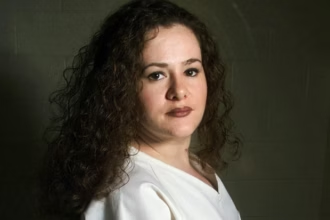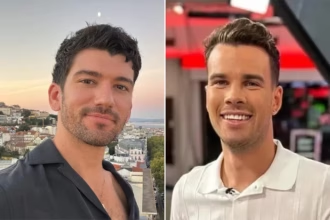





In 2023, two Utah siblings became the centre of a case that was hard to look away from and even harder to fully understand.
Ty Larson and his younger sister, Brynlee Larson, also known as Bryn, barricaded themselves inside a bedroom for 54 days. They were not hiding from strangers. They were not caught in a hostage situation in the usual sense. They were refusing to follow a court order that would have sent them into a reunification process with their biological father, Brent Larson, a man they had accused of abuse.

Their story spread across TikTok, news sites and family court reform circles. Videos from inside the room turned a private custody battle into a public spectacle. Some people saw two terrified children trying to be heard. Others saw the case as another example of how bitter family disputes can become nearly impossible to untangle once courts, therapists, parents, social media and allegations of abuse are all involved.
Now, the case is back in the spotlight through the ABC News Studios docuseries The Nightmare Upstairs: What Happened to Ty and Bryn? The two-part series is streaming on Hulu in the United States and is also available through Disney+ in some regions, including via Hulu on Disney+ where available. Hulu lists the series as a 2026 crime docuseries, with episodes titled “Shocking Allegations Rock A Family” and “54 Days in the Barricade.”
The title alone gives the story a kind of horror-movie feeling. But what makes the case so unsettling is that it happened in the ordinary rooms of a family home, inside courtrooms, and across livestreams watched by strangers.
Who Are Ty and Brynlee Larson?
Ty and Brynlee Larson are siblings from Utah who became widely known after their 54-day bedroom barricade in late 2022 and early 2023. At the time, Ty was 15 and Brynlee was 12. They were involved in a long-running custody dispute between their mother, Jessica Zahrt, and their biological father, Brent Larson.
The siblings had accused Brent Larson of emotional and sexual abuse. Brent denied the allegations and argued that the children had been influenced against him, a claim often described in custody disputes as “parental alienation.” No criminal charges were filed against him. However, according to reporting by ProPublica and later coverage of the case, Utah’s Division of Child and Family Services found the children’s allegations to be “supported” in 2018.
That contrast is one reason the case drew so much attention. To many people following the story, the question was simple: if child welfare investigators had supported the allegations, why were the children still being ordered into reunification with the father they feared?
The legal answer was far more complicated. Family court cases often move through a different system than criminal cases. A child welfare finding does not automatically lead to a criminal conviction. A lack of criminal charges also does not always mean a child’s claims were dismissed by every agency involved.
That grey area became the centre of the Larson case.
The Custody Fight Before the Barricade
The conflict did not begin with the viral videos. The roots of the case stretch back years.
According to ProPublica, allegations involving Brynlee were found “supported” by Utah’s Division of Child and Family Services in April 2018. Later that year, Ty also disclosed allegations, and DCFS found his claims of sexual and emotional abuse to be “supported” as well. ProPublica reported that the agency described the allegations as “severe and chronic.”
Brent Larson denied the allegations. His side argued that the children’s refusal to see him was the result of alienation, not abuse. That argument became central in the court process.
The case eventually moved toward a court-ordered reunification plan. According to People, a judge ordered Ty and Brynlee to live with their father for 90 days without contact with their mother, Jessica Zahrt. The siblings strongly opposed that order.
For Ty and Brynlee, the order appeared to represent the thing they feared most. For the adults and professionals involved, it was part of an attempt to repair a fractured parent-child relationship.
That clash is what made the case so explosive. It was not just a dispute about parenting time. It became a battle over whose version of reality the system believed.
The 54-Day Bedroom Barricade
When the court order came, Ty and Brynlee did something extreme.
They locked themselves inside a bedroom at their mother’s home and refused to come out.
The barricade lasted 54 days. During that time, Ty livestreamed parts of the ordeal on TikTok. The videos showed the siblings living in a room while the legal battle unfolded outside the door. Their situation quickly moved beyond Utah and into national attention.
According to ABC7’s coverage of the docuseries, co-director and executive producer Caitlin Keating described the barricade as something livestreamed “day and night.” The two-part series includes police interviews, court material and footage connected to the standoff.

The livestreaming changed everything.
Without social media, the case may have remained one more family court file. With it, strangers began watching in real time. Supporters rallied around the siblings. Critics questioned the role of social media in such a sensitive case. Family court observers saw a dramatic example of a broader debate: how should courts respond when children refuse reunification with a parent they accuse of abuse?
The longer Ty and Brynlee stayed inside the room, the more pressure grew around the case.
Why the Case Became So Controversial
The Ty and Brynlee Larson case became controversial because it touched several painful issues at once.
There were allegations of abuse. There was a father who denied wrongdoing. There was a mother accused by the other side of influencing the children. There were court orders, reunification therapy, child welfare findings and a public campaign taking place on TikTok.
People wanted a clear villain and a clear answer. The legal system rarely works that neatly.
One of the most disturbing parts of the case for many observers was the gap between the child welfare findings and the family court outcome. ProPublica reported that DCFS had supported allegations made by the children in 2018, but the children were still facing a court order that would have transferred them to their father’s custody for a period of time.
At the same time, Brent Larson continued to deny the allegations. He was not criminally charged. That fact is important, especially in any responsible coverage of the case.
The documentary appears to lean into that tension. It does not simply ask what happened inside the upstairs room. It asks how a family reached the point where two children believed locking themselves away was their only option.
What Happened After the Barricade Ended?
The barricade did not end with police forcing Ty and Brynlee out of the room.
In March 2023, Judge Derek Pullan delayed enforcement of the custody order after new information came forward about serious allegations and a criminal probe, according to ProPublica. The siblings then emerged after almost two months inside the room.
That did not mean the wider legal battle was over.
People reported that after the barricade, Ty sought emancipation and lived independently for a time before later returning home. Brynlee’s custody situation also continued through the courts. Eventually, both siblings were living with their mother, Jessica Zahrt.
Later reporting tied to the docuseries says Brent Larson ultimately voluntarily relinquished his parental rights in 2024 after mediation connected to another petition from Zahrt. People also reported that this happened six years after the first allegations surfaced.
That decision marked a major turning point. After years of court fights, professional assessments, disputed claims and public attention, the legal battle moved toward closure.
Where Are Ty and Brynlee Larson Now?
As of 2026, Ty and Brynlee Larson are no longer living inside the crisis that made them famous online.
People reported that both siblings now live with their mother, Jessica Zahrt. Ty had previously sought emancipation and lived away from home, but later returned. Brynlee is also living with Zahrt, who has custody of her.
Biography.com reported that Ty remains active on TikTok and has shown support for Om’s Law, legislation associated with another high-profile child custody tragedy. Brynlee’s life appears to be less public, though she participates in the Hulu docuseries and has spoken about healing.
People’s later “where are they now” reporting also described the siblings as focusing on healing and self-growth. Ty reportedly graduated high school early and shares tech-related content, while Brynlee has used art and social media as part of her recovery.
That is perhaps the most important part of the “where are they now” answer. They are not just viral names from an internet moment. They are young people trying to move forward after years of public and private turmoil.
Where Are Brent Larson and Jessica Zahrt Now?
The documentary also looks at the two parents whose custody fight shaped the case.
Jessica Zahrt, the children’s mother, remained central in the legal battle. After the barricade and later proceedings, she was awarded custody of Brynlee, while Ty’s legal situation included his emancipation effort before returning home.
Brent Larson denied the allegations against him throughout the case. People reported that he eventually voluntarily relinquished his parental rights following mediation. Biography.com also reported that he made that decision in 2024.
What Is The Nightmare Upstairs About?
The documentary includes the perspectives of the family members and attempts to show how the case looked from different sides. That does not make the story easy. In fact, it may make it harder, because viewers are not just watching a single incident. They are watching years of mistrust, legal conflict and emotional damage build toward a breaking point.
The Nightmare Upstairs: What Happened to Ty and Bryn? is a two-part docuseries from ABC News Studios.
The series follows the case of Ty and Brynlee Larson, their 54-day barricade and the custody dispute that led to it. The Hulu listing describes the show as a 2026 crime docuseries. The episodes focus first on the allegations that rocked the family and then on the 54 days the siblings spent barricaded inside the room.
The series has also been promoted through Disney platforms. In Australia and some other markets, viewers may see it through Disney+ rather than Hulu as a standalone service. Rotten Tomatoes lists the series as available through Disney+ and Hulu.

The documentary uses court hearings, police interviews and family footage to tell the story. It also places the case within a bigger debate about family court, reunification therapy and how systems handle children who make abuse allegations during custody disputes.
Why This Case Still Matters
The Larson case is not just a viral true crime story. It raises questions that go beyond one family.
What should happen when children refuse court-ordered reunification? How should courts weigh child welfare findings against claims of parental alienation? What happens when a family court case becomes a social media event? And how can systems protect children while also avoiding rushed conclusions in bitter custody disputes?
Those questions do not have simple answers.
What is clear is that Ty and Brynlee’s case exposed a deep lack of public trust in parts of the family court process. Many people who followed the story believed the children had been forced to fight too hard to be heard. Others worried about the influence of online attention on a case involving minors and serious allegations.
The documentary arrives at a time when true crime viewers are asking for more than shock value. Audiences increasingly want context, accountability and careful reporting. The Nightmare Upstairs stands out because the “crime” element is not a single police investigation or courtroom verdict. It is the story of a family system breaking down in public.
Final Thoughts
The story of Ty and Brynlee Larson is difficult because it does not fit into a neat headline.
It is about two children who barricaded themselves in a bedroom for 54 days because they were terrified of a court order. It is about allegations that were supported by child welfare investigators, denied by their father and never tested through criminal charges. It is about a mother, a father, a courtroom, a livestream and a system that left many people wondering how things reached that point.
Now, with The Nightmare Upstairs, the case has moved from TikTok feeds and legal documents into a polished documentary format. But behind the title are two young people who lived through something most viewers can only imagine.
Ty and Brynlee Larson are now trying to move forward. The viral moment has passed, but the questions their case raised are still very much alive.
For viewers, the documentary is not just about what happened upstairs. It is about what happens when children say they are afraid, the adults disagree about why, and the system has to decide what to do next.
FAQ
What is The Nightmare Upstairs about?
The Nightmare Upstairs: What Happened to Ty and Bryn? is a two-part documentary series about Utah siblings Ty and Brynlee Larson, who barricaded themselves in a bedroom for 54 days during a custody dispute involving their biological father, Brent Larson.
Where can you watch The Nightmare Upstairs?
The series is streaming on Hulu in the United States and is also listed on Disney+ in some regions, including through Hulu on Disney+ where available.
Why did Ty and Brynlee Larson lock themselves in a room?
They refused to comply with a court-ordered reunification process involving their father, Brent Larson, whom they had accused of abuse. Brent Larson denied the allegations and was not criminally charged.
Were the allegations against Brent Larson proven in criminal court?
No. Brent Larson denied the allegations and was not criminally charged. However, ProPublica reported that Utah’s Division of Child and Family Services found the children’s allegations to be “supported” in 2018.
Where are Ty and Brynlee Larson now?
As of recent reporting tied to the documentary, both siblings are living with their mother, Jessica Zahrt, and focusing on moving forward after the long-running custody battle.